
The male Vermilion Flycatcher stands out like a crimson flame, pulsating brightly against a drab background of dark leaves. Its brilliant, glowing red body and head contrast sharply with a dark charcoal back, wings, and tail, along with a rakish eye mask that makes it look like a miniature bejeweled bandit. Its female partner is much duller but equally distinctive, with gray-brown upperparts, a whitish breast with faint streaks, and a characteristic salmon-pink or yellowish wash on the belly. Juvenile birds start out quite streaky and progressively develop the traits of adult males or females. Once a rare Southwest desert visitor to Orange County, the Vermilion Flycatcher has recently taken up year-round residence in Huntington Central and Fairview Parks, where intrepid males have established and…

Archives
Bird of the Month: Black-headed Grosbeak

If you hear an especially rich, sweet warble coming from the trees next spring, take a closer look. You may be hearing one of our colorful seasonal visitors: the Black-headed Grosbeak (Pheucticus melanocephalus). Black-headed Grosbeaks are substantial songbirds, with chunky bodies, relatively short tails, and enormous triangular bills built for cracking seeds and nuts. Breeding males are particularly striking, with burnt-orange bodies, black heads, wings and tails, and bold flashes of white on their wings. Females and immature males are more subtly colored, with boldly striped heads, streaked brown backs, and warm tawny breasts. A Springtime Return Black-headed Grosbeaks spend the winter in Mexico and return north in spring to breed throughout much of the western United States, including coastal California. They build relatively flat,…
July Bird of the Month: The Scaly-breasted Munia
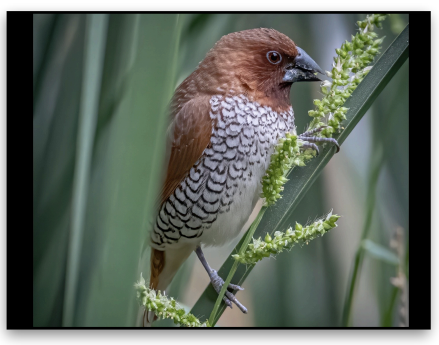
Sea & Sage Audubon’s July Bird of the Month is the Scaly-breasted Munia (Lonchura punctulata), a tiny songbird that has become a familiar sight in Orange County over the past three decades. Native to South and Southeast Asia, the Scaly-breasted Munia is not native to California. It is believed to have become established in Southern California through escaped or released pet birds and is now commonly found in brushy riparian habitats, grasslands, parks, and gardens. Highly social, these active little birds are often seen in noisy flocks, climbing grass stalks in search of seeds or foraging on the ground. Adult munias are easy to recognize by their rich chocolate-brown upperparts, dark heads, stout black beaks, and distinctive pale underparts covered with scale-like markings that give…