

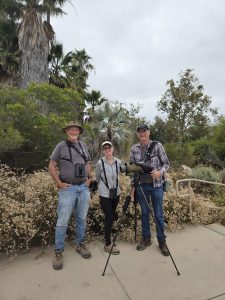
 On a quiet June morning, before the Environmental Nature Center opened to visitors, three experienced birders gathered at the gate.
Their task was to conduct a breeding bird survey — documenting the species present on the property, noting evidence of nesting activity, and creating a baseline record of the birds that call the ENC home.
For one member of the survey team, however, the morning represented something more than data collection.
Nearly fifty years earlier, Brian Bleecker had stood on this same property as a Newport Harbor High School student.
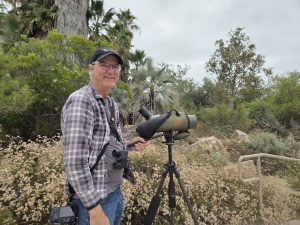 Brian attended Newport Harbor High School from 1974 to 1976 and was a student in Robert House’s biology class during the early years of the Environmental Nature Center. Like many students of that era, he didn’t simply learn about nature at the ENC — he helped build it.
He remembers spreading mulch, planting trees and shrubs, and participating in some of the first informal bird surveys conducted on the site. The Environmental Nature Center was still young then. Many of the trees were small. The habitats were just beginning to take shape.
No one could have known exactly what those plantings would become.
Today, the Environmental Nature Center is home to mature native landscapes, thriving wildlife habitat, and environmental education programs that serve tens of thousands of people each year. The saplings planted by students and volunteers have become towering trees. The gardens have matured. Generations of children have explored the trails.
And Brian never stopped paying attention to the natural world.
After retiring from a career in retail management, he devoted even more time to birding and conservation. Today he is a highly skilled birder and active volunteer with Sea and Sage Audubon Society and the Coastal Corridor Alliance, helping conduct bird surveys and monitoring projects throughout Orange County.
When Brian returned to the ENC in June 2026 as part of a breeding bird survey team, he did so not as a student, but as an expert.
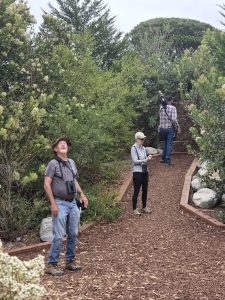 Together with fellow birders Betty Kanne and Jim Kendall, he spent the morning documenting breeding activity and bird populations across the campus. The survey will help establish a valuable baseline record at an important moment in the Center’s history.
But perhaps the most meaningful observation that morning wasn’t recorded on a checklist.
It was the simple fact that nearly fifty years after helping plant the Environmental Nature Center, Brian had returned to help document the wildlife those habitats now support.
Environmental education often unfolds quietly. A child attends a field trip. A teenager plants a tree. A student participates in a bird survey.
The results may not be visible immediately.
Sometimes they take decades.
Brian’s story is a reminder that the true impact of places like the Environmental Nature Center cannot always be measured in a single day, a single program, or a single season. Their influence grows over time through the lives they touch.
The trees grow.
The habitats mature.
The students become stewards.
And occasionally, they come home.